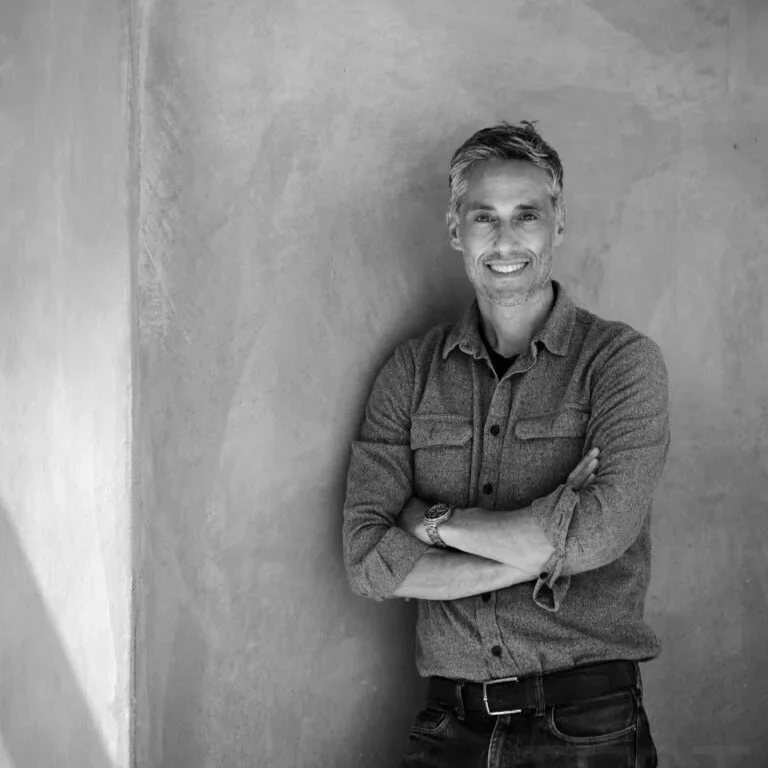
Image: Jess Field; Photographer, Joe Fletcher
Grassi is proud to partner with some of the Bay Area’s most talented architects, interior designers, and artisans. Among them is Jess Field of Field Architecture. With roots in South Africa, Jess leads the Palo Alto–based practice, with his father Stan serving in an emeritus role. Stan studied under modernist icon Louis Kahn, an influence that continues to inform Jess’s thoughtful, grounded approach. FIELD begins each project with the land, carefully considering climate, topography, soil, hydrology, flora, and fauna. Grounded in a deep commitment to craftsmanship, Jess engages technology as an essential counterpart, linking design and fabrication. His ideas are often expressed through exploratory and evocative hand drawings.
GAA: Your father introduced you to vernacular hut construction and to the work of Louis Kahn. How do those seemingly different influences converge in your practice?
JF: My father studied with Lou Kahn at Penn, and that language of structure, material, and light filled our home: books, drawings, pencils in every room. But what was most magnetic to me as a child was the way my father extended Kahn's thinking into the natural world around us. The boulders, the grasslands, and the trees of South Africa were what consumed his attention.
For his first project, the Miller House, on a site on the outskirts of Johannesburg covered in large granite boulders, he slept on the land for seven nights before drawing a single line. He carved sculptures of each boulder from Imbuya wood to understand their form completely. Then he made two rules: no boulder would be moved, and no man-made structure would touch one. The house grew entirely from those conditions.
I grew up admiring those wooden sculptures. When I visited the house as a child and saw the actual boulders, with light grazing across them through the skylights, architecture suddenly came to life for me. I understood for the first time what a building could do.
The Miller House is now over fifty years old. The boulders and native vegetation still run through it. When my father and I formally joined practice and founded FIELD, that relationship with the land became the foundation of everything we have built together since.
GAA: Field Architecture is known for buildings that feel firmly anchored in their sites. What is your first step when approaching a new piece of land?
JF: To understand it without preconception.
There are many layers to a site: topography, light, geology, hydrology, wind, and the patterns of wildlife moving through it. Getting to know a place takes time and genuine immersion. There are no shortcuts, and honestly, there are few things I love more.
At Big Sur, after countless hours on the site, we discovered a ravine buried under decades of accumulated debris. Beneath it, an intermittent coastal stream. We uncovered it, spanned it with a bridge, and placed it at the heart of the house. That stream is still running through it.
Every site carries something like that. Our buildings grow from that understanding.
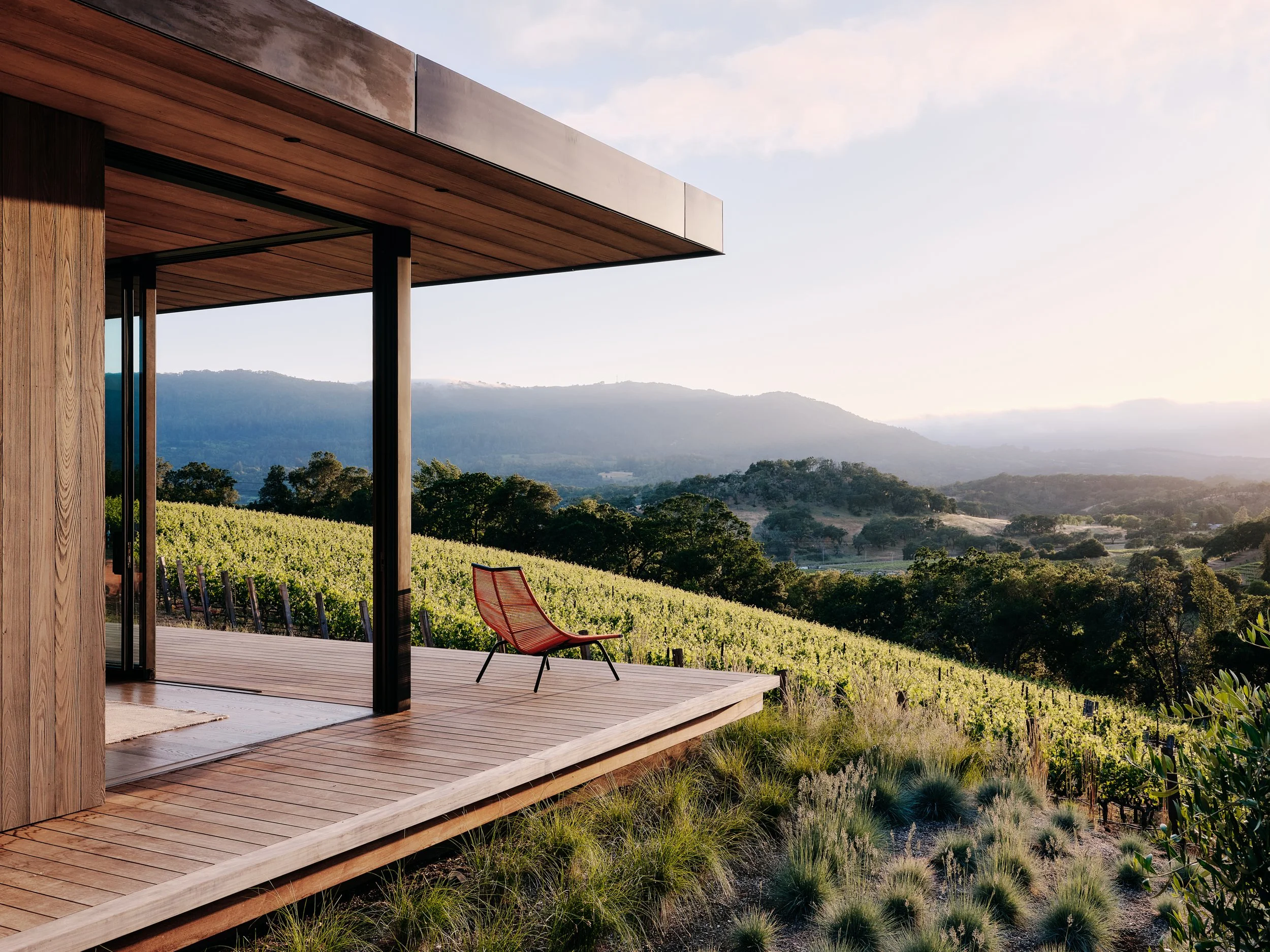
Image: 12 Moons, Field Architecture, Grassi & Associates, Erin Martin Design, Lutsko Associates Landscape; Photographer, Joe Fletcher
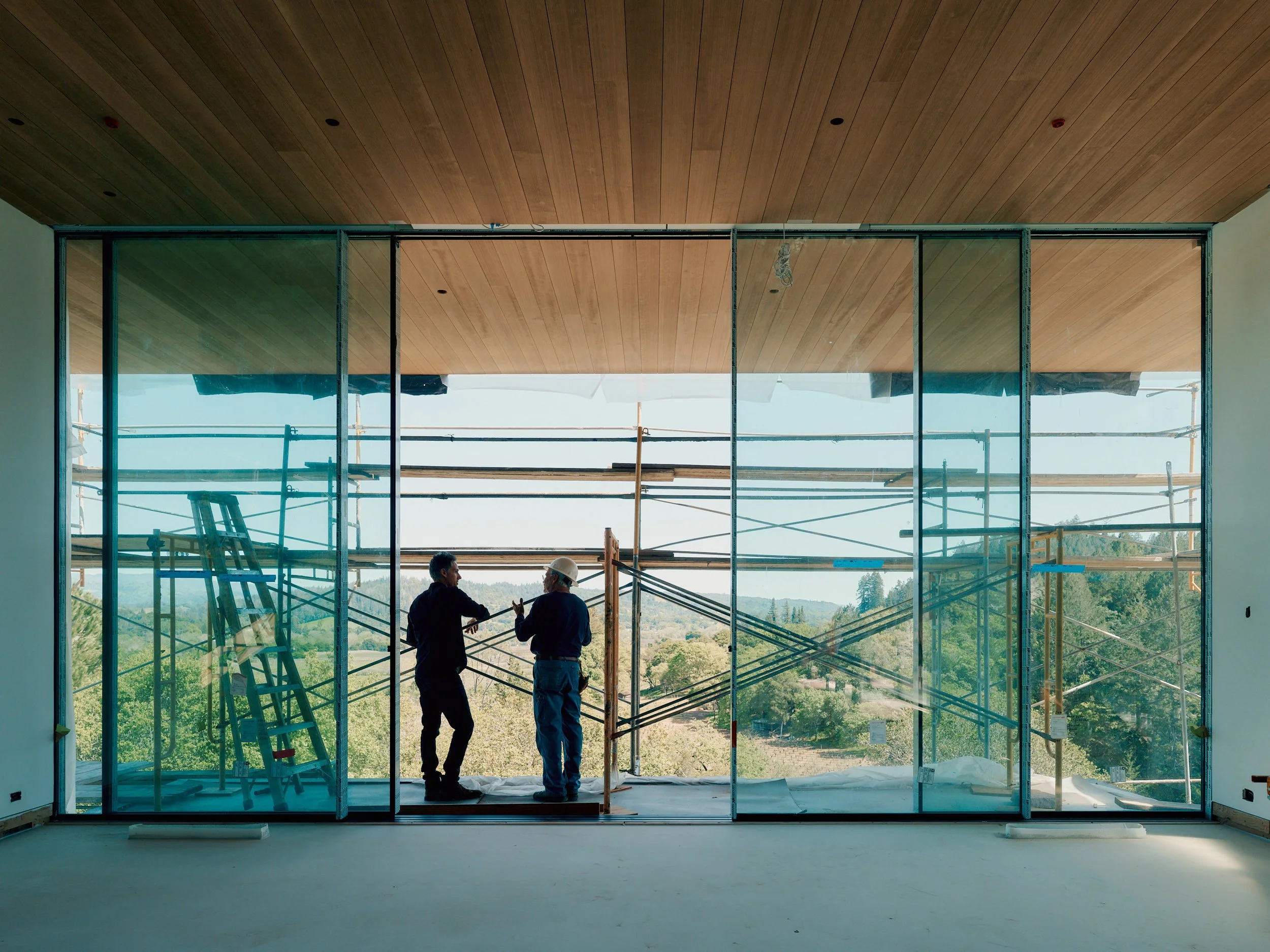
Image: Steve Schlesinger and Jess Field at Arroyo site; Photographer, Joe Fletcher
GAA: What makes designing in Napa Valley unique compared to other regions?
JF: It's a striking landscape of mountains and valleys, each with their own distinctive character. The dry, open Vaca Range to the east and the denser, more forested Mayacamas to the west, with the cultivated valley floors caught between them and wild hillsides rising on either side. Everything can be traced back to the path of water through that landscape. It was a natural fit for our whole approach to the land.
There is also a deep culture of craft. Things are made carefully and held to a high standard. When I first discovered that, nearly two decades ago, it was genuinely exciting. The work must belong, and it must endure, contemporary in its thinking but connected to the place. Shortly after we completed Zinfandel, a neighbor who had lived nearby for four decades stopped by and told us the building felt like it had always been there. I took that as a great compliment.
GAA: What does “timelessness” mean to you in residential architecture?
JF: I've always been drawn to buildings that have stood the test of time. Visiting Kahn's works has been a powerful source of inspiration, particularly the Salk Institute. The way it engages the coastal bluff and understands how powerful the space between structures can be, rather than the structures themselves. These are the things that transcend style.
I'm also a surfer, and have spent many hours in the water below those same cliffs waiting for waves. From that vantage point, the Salk Institute makes sense. It asks the right questions about light, about sun, about water, about a space that sits at the edge of the continent. When a building does that, it doesn't need anything else to carry it.
That's what timelessness means to me. Proportion, material, structure, and site are in alignment; when they are, the building feels inevitable, something that could not be otherwise.
GAA: Your projects often feel quiet yet powerful. How do you achieve that tension?
JF: By removing what is unnecessary. What remains is resolved with care. How a wall meets the ground. How light enters a room. How one material transitions to another. Each detail is considered as if it were the only one in the house.
When every decision is made with that level of attention, the details begin to recede and the whole comes forward. The work becomes quiet. The care in how it is made supports a deeper relationship between the building and the land, and shapes the experience of living within it.
GAA: You often use stone, steel, and wood in raw, expressive ways. What draws you to these materials?
JF: Each material has an inherent logic: how it is formed, how it carries load, how it weathers. When you work with that logic rather than against it, the material doesn't need to be disguised. We allow materials to be what they are.
On a project we recently completed in Idaho’s Wood River Valley, Idaho, we used reclaimed barn wood salvaged from a hundred-year-old structure on the Camas Prairie. We sorted every board by its original orientation and kept that orientation in the new house. South-facing boards went south, north-facing boards went north. A century of distinct exposure had shaped the same material completely differently. We had to honor that. The new home gives that material continuity, shaped by the same forces of sun and water that formed it over a hundred seasons.
That's what draws me to these materials. Over time, they deepen. They record where they've been.
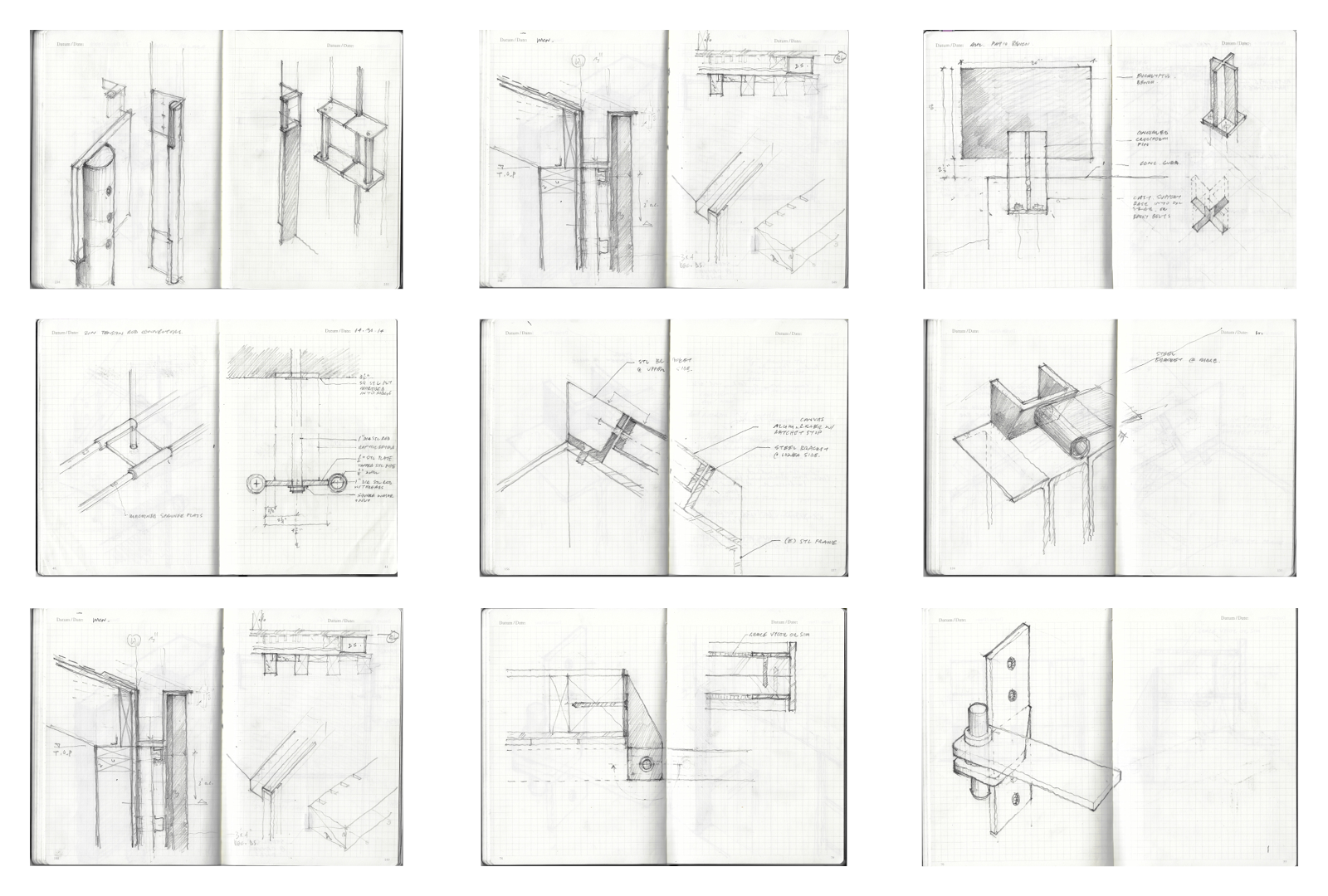
Image: Jess Field’s sketches
GAA: What role do artisans and builders play in refining your designs?
JF: Architecture is realized through the hands of others. The more closely I understand those hands, what they can do easily and what requires effort, the more precisely the work can be conceived.
My first project with Grassi, outside of Yountville, set the foundation for everything that followed. I formed a close working relationship with Mark, Paul, our superintendent Phil, and master carpenter Steve. We threw ourselves into it completely. Every detail, every material intersection was discussed and resolved together. I still have the sketchbooks from that project, chronicling the development of every junction in the building. That process taught us what each of our gifts was and laid the foundation for creating exceptional work together.
With Grassi, that understanding has been built over many years, grounded in trust. We can reach for something exacting and know it will be carried through with the same conviction. That alignment allows the work to be strengthened in construction rather than diminished by it.
GAA: What advice would you give young architects who want to create work that feels both contemporary and deeply rooted in place?
JF: Look less at images and more at the world.
Study how buildings meet the ground. Pay attention to materials as they age. Understand how light changes a space over the course of a day.
And be patient. Work that is grounded is not produced quickly. It is shaped over time, through attention and restraint. Every project is a great responsibility and a unique opportunity. Learn everything you can from it.